What is the handmade web?
The term handmade web describes web pages coded by hand, made and maintained by individuals rather than by companies. This lecture looks at where the term comes from and at the people who still make websites by hand today.
The term handmade web describes web pages coded by hand, made and maintained by individuals rather than by companies. This lecture looks at where the term comes from and at the people who still make websites by hand today.
J.R. Carpenter is a British-Canadian artist and writer, born in Nova Scotia in 1972. She has been making web-based works since the mid-1990s, and her practice mixes digital literature with performance and print. In March 2015, she presented a short text called A Handmade Web at the Slow Media conference at Bath Spa University, later printed in Uniformagazine in 2016.
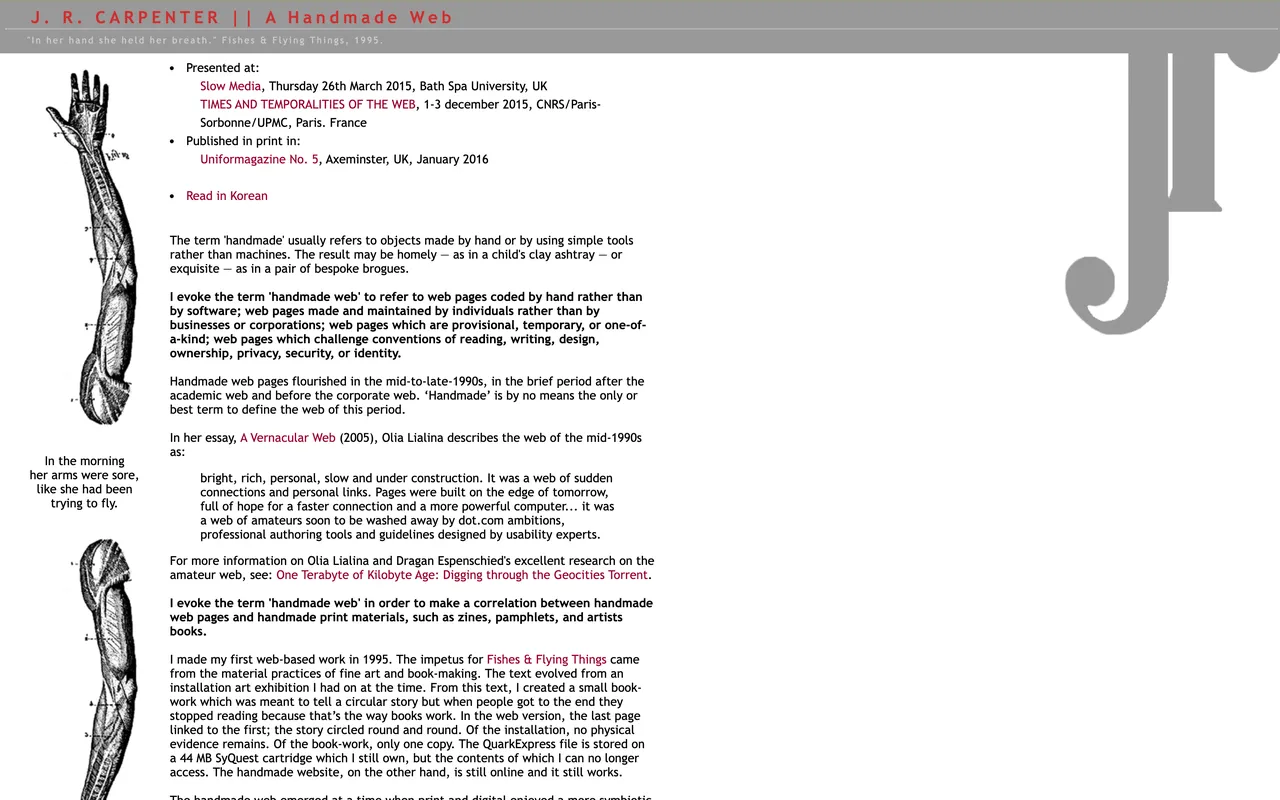
A Handmade Web, J.R. Carpenter, 2015. Like the rest of her website, the page is laid out with fixed-width table cells, from a template she made in HomeSite in 1997. luckysoap.com/statements/handmadeweb.html
I evoke the term ‘handmade web’ to refer to web pages coded by hand rather than by software; web pages made and maintained by individuals rather than by businesses or corporations; web pages which are provisional, temporary, or one-of-a-kind; web pages which challenge conventions of reading, writing, design, ownership, privacy, security, or identity.
J.R. Carpenter, A Handmade Web, 2015
Carpenter’s text returns several times to the same opening words, “I evoke the term ‘handmade web’”, and each time adds something to the definition. For her, the handmade web is:
Readers have had the option of right-clicking on any page, selecting View Page Source, copying, pasting, and re-writing the source code. In this manner, readers become writers.
J.R. Carpenter, A Handmade Web, 2015
Carpenter gives the example of Taroko Gorge (2008), a small poetry generator by Nick Montfort whose source code has been rewritten by dozens of readers. She rewrote it three times herself. She also points out that phones and tablets broke this habit: on an iPhone or an iPad, there is no “View Page Source”.
In today’s highly commercialised web of multinational corporations, proprietary applications, read-only devices, search algorithms, Content Management Systems, WYSIWYG editors, and digital publishers it becomes an increasingly radical act to hand-code and self-publish experimental web art and writing projects.
J.R. Carpenter, A Handmade Web, 2015
Just before this passage, Carpenter proposes slowness and smallness as forms of resistance.
The word handmade only makes sense in opposition to something made by machines. This opposition is much older than the web. It goes back to the Industrial Revolution, when writers and designers in 19th-century England began to defend craft against industrial production.
We want one man to be always thinking, and another to be always working, and we call one a gentleman, and the other an operative; whereas the workman ought often to be thinking, and the thinker often to be working, and both should be gentlemen, in the best sense.
John Ruskin, “The Nature of Gothic” in The Stones of Venice, 1853
In this chapter, the critic John Ruskin praises the irregularities of Gothic stone carving as the trace of free workers, who were allowed to think about what they made. He sets them against the perfect finish of industrial goods, which depends on a strict division of labour between the people who design and the people who execute.
William Morris turned these ideas into a practice. With the Arts and Crafts movement, he defended handmade wallpaper, textiles, furniture and books against industrial production. In 1891, he founded the Kelmscott Press, where books were printed on a hand press, on handmade paper. One of its early books, in 1892, was Ruskin’s The Nature of Gothic, with a preface by Morris.
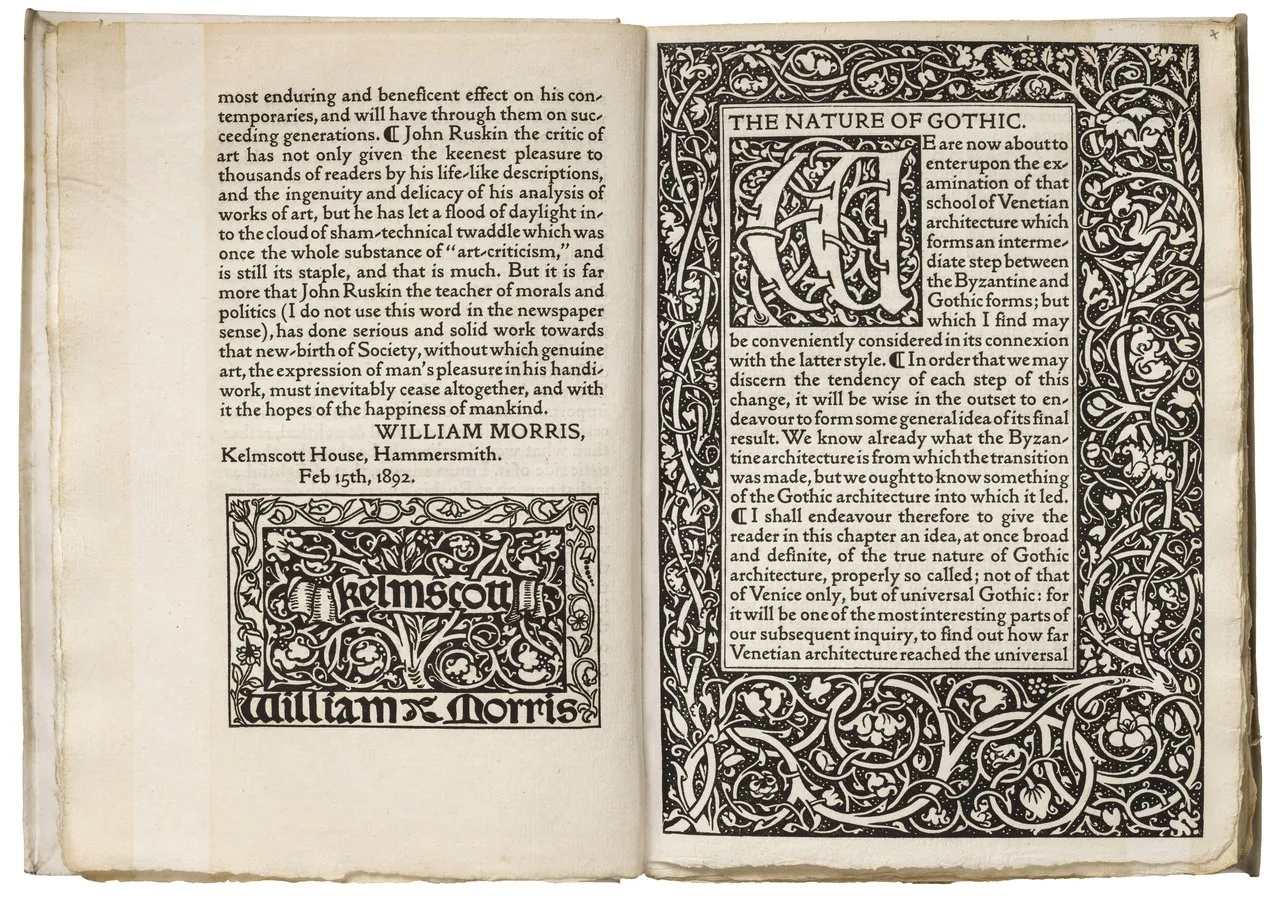
The Nature of Gothic, John Ruskin, printed by William Morris at the Kelmscott Press in 1892. Morris drew the typefaces and ornaments of the press himself.
The division Ruskin described has an equivalent on the web. From the 2000s onwards, CMS and templates separated the people who build websites from the people who fill them with content, and in many studios, design and development became two separate jobs. A handmade website puts these roles back in the same hands: whoever writes the page also designs and codes it.
Craftsmanship names an enduring, basic human impulse, the desire to do a job well for its own sake.
Richard Sennett, The Craftsman, 2008
For the sociologist Richard Sennett, craft is a dialogue between the hand and the head, and skill grows slowly, through practice and through the resistance of the material. This is close to how HTML and CSS are learnt by hand, by trial and error.
According to Carpenter, handmade web pages flourished in the mid to late 1990s, “in the brief period after the academic web and before the corporate web”. Many personal pages of the time were written directly in HTML, often by people who had learnt it a few weeks earlier by copying the source of other pages.
It was bright, rich, personal, slow and under construction. It was a web of sudden connections and personal links. Pages were built on the edge of tomorrow, full of hope for a faster connection and a more powerful computer… it was a web of amateurs soon to be washed away by dot.com ambitions, professional authoring tools and guidelines designed by usability experts.
Olia Lialina, A Vernacular Web, 2005
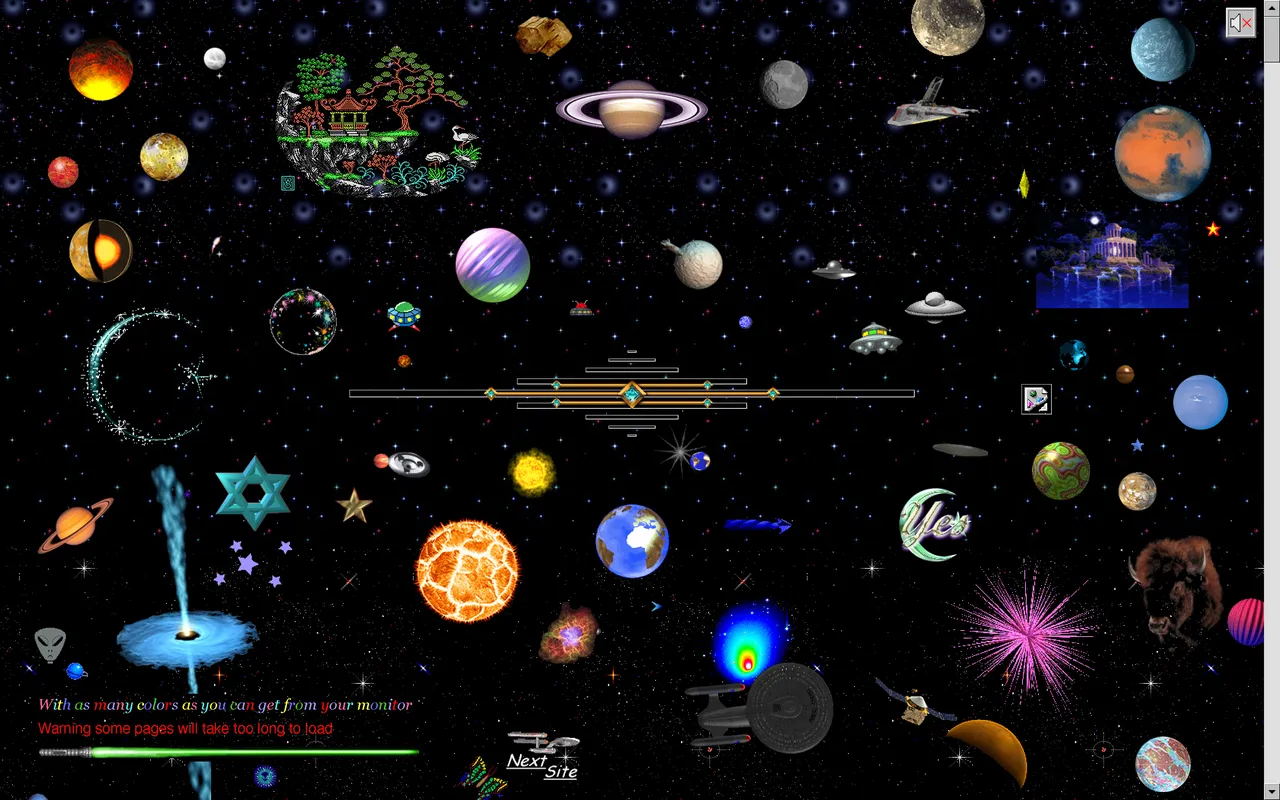
Cameron’s World, Cameron Askin, 2015. A web collage of texts and images taken from archived GeoCities pages. When the American service closed in 2009, it hosted more than 38 million pages, most of them personal homepages. cameronsworld.net
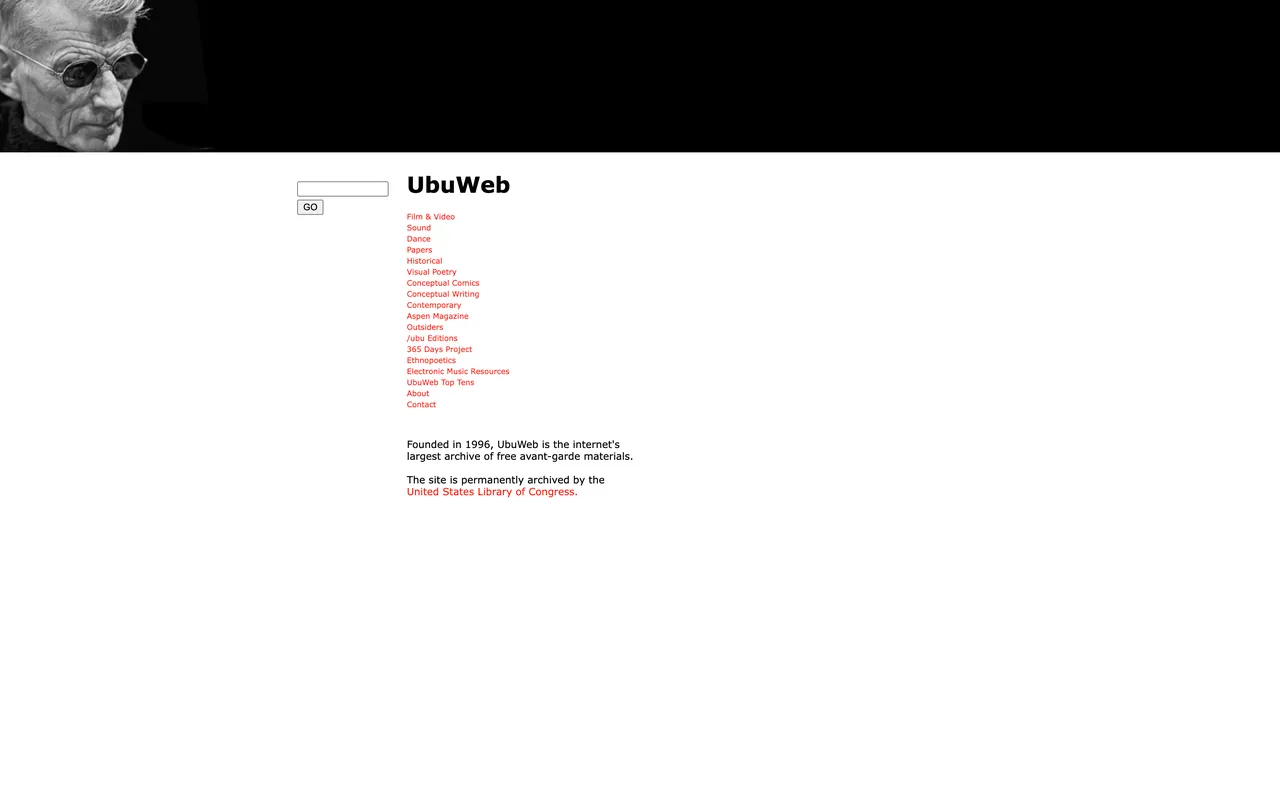
UbuWeb, founded by the poet Kenneth Goldsmith in 1996, is an independent archive of avant-garde poetry, film, music and sound. In 2014, its founder wrote that “the whole damn site is still hand-coded in html 1.0 in bbedit, from templates made in 1996.” ubu.com
I believe every material has a grain, including the web.
Frank Chimero, The Web’s Grain, 2015
The designer Frank Chimero borrows the idea of grain from materials like wood, where a good craftsperson works along the grain. For him, the grain of the web is its lack of edges, with pages of any length and screens of any size. He suggests treating the web as a material to build with, instead of a blank canvas to paint on.
Since the mid-2010s, artists, designers, writers and hobbyists have been going back to small websites made by hand. Some borrow the look of the 1990s, most use today’s HTML and CSS. Many of them also build tools, platforms and events so that others can do the same.
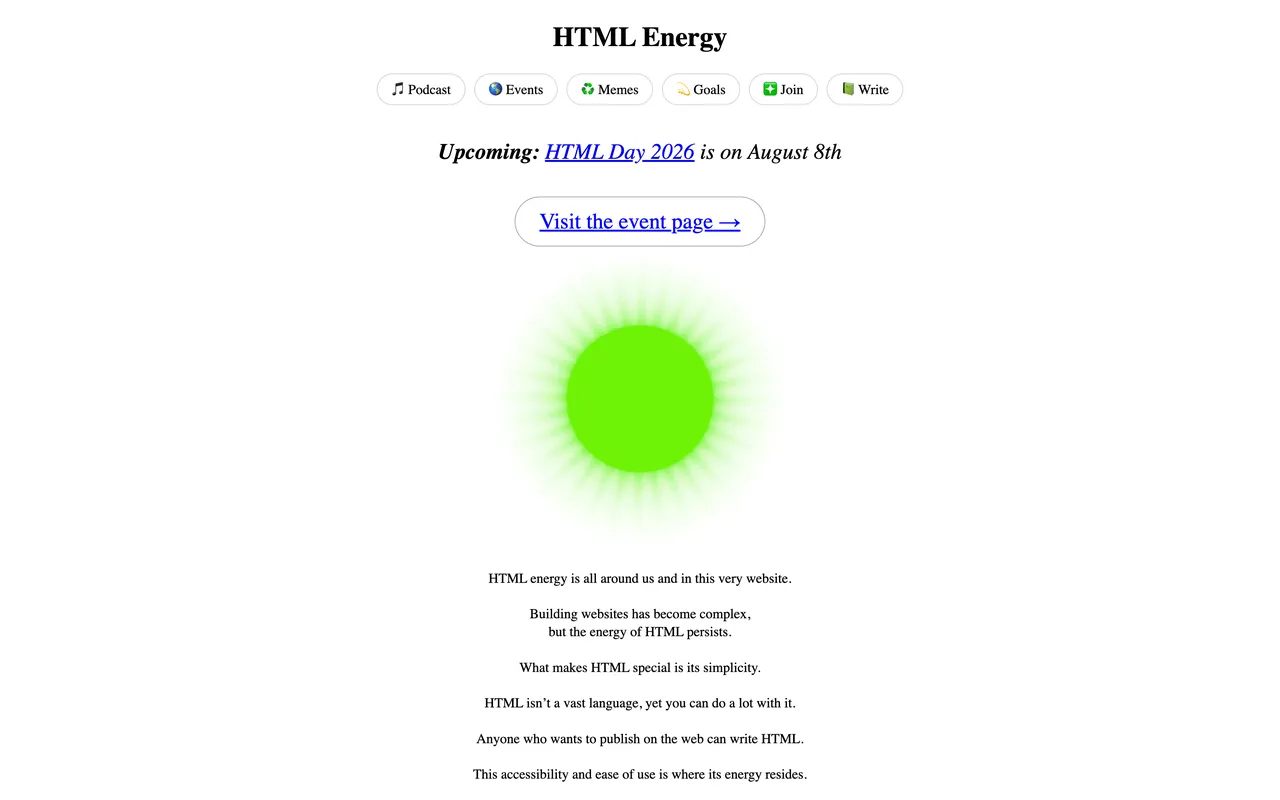
HTML Energy is run by Laurel Schwulst and Elliott Cost. They organise freewrites, sessions where people meet to write HTML together, and, every summer, HTML Day, a worldwide gathering to make web pages by hand. For them, “anyone who wants to publish on the web can write HTML.” html.energy
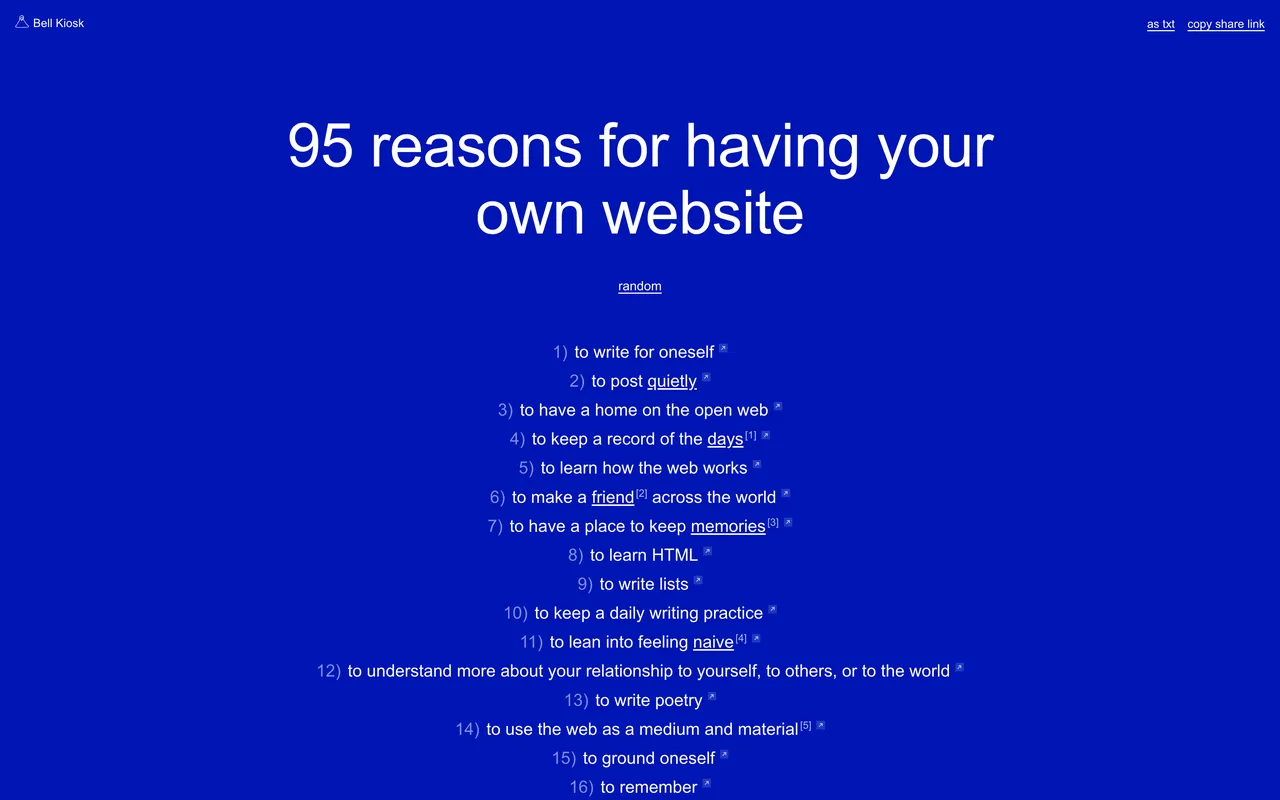
Bell Kiosk is the web studio and website repair shop of Elliott Cost, which “makes websites by hand for humans”. On its blog, a running list of 95 reasons for having your own website in 2026 includes “to learn how the web works”, “to keep things unfinished and open ended” and “to remember that a website is just files & folders”. bellkiosk.website/blog/reasons-to-website.html
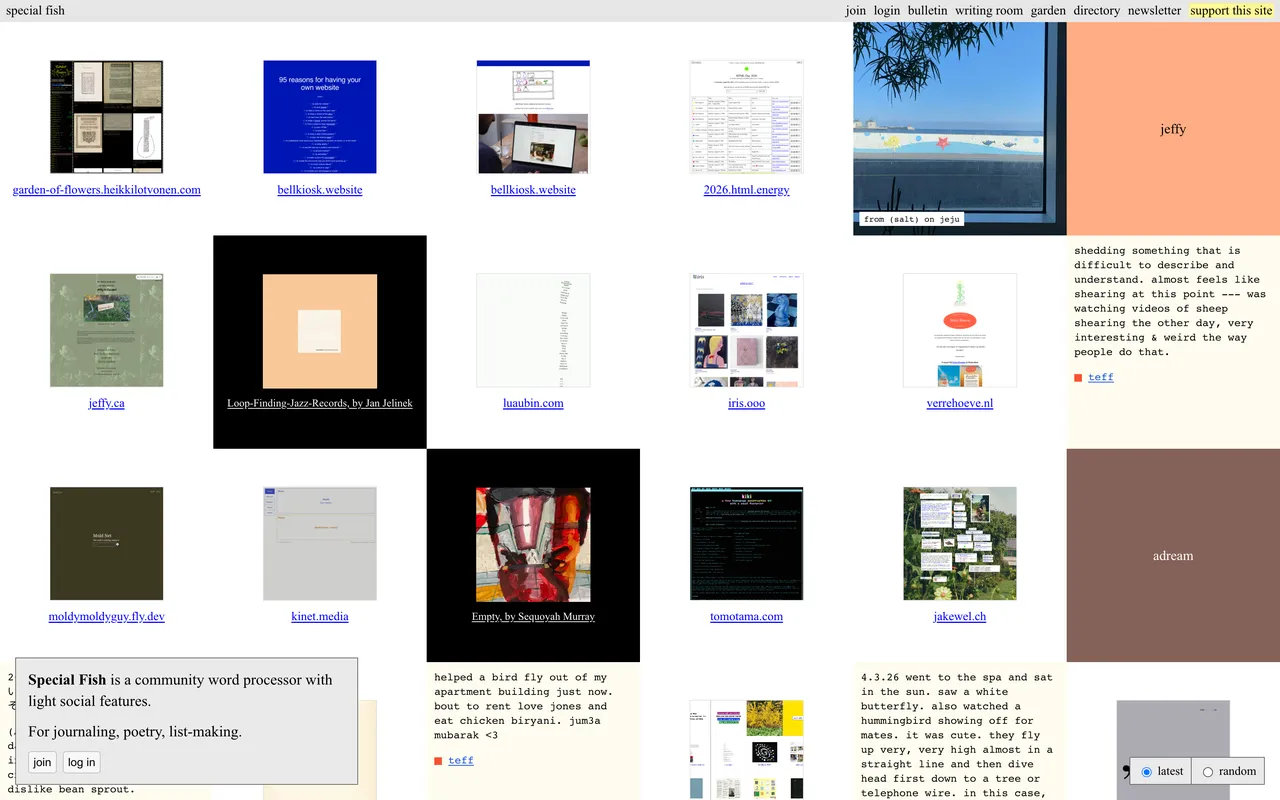
Special Fish, also by Bell Kiosk, describes itself as “a community word processor with light social features. For journaling, poetry, list-making.” A small social platform, far from the scale and the metrics of social media. special.fish
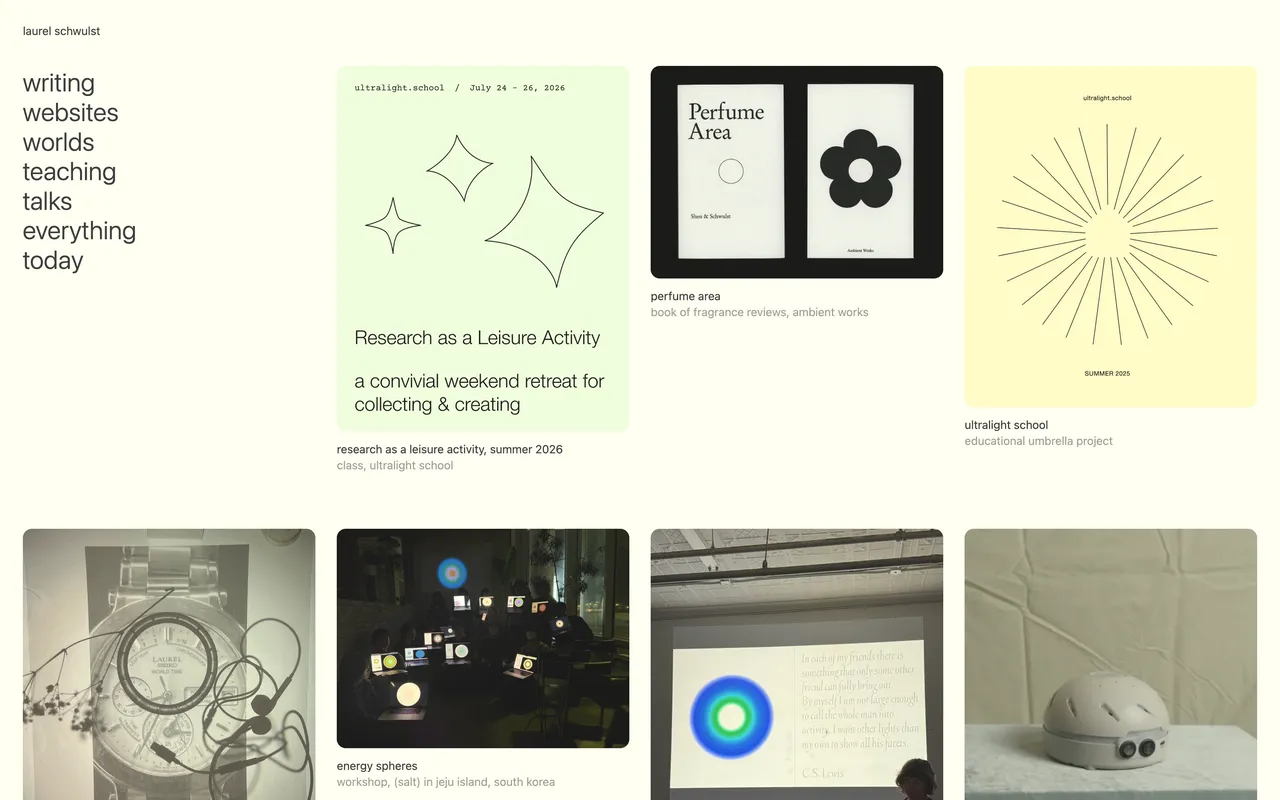
The website of Laurel Schwulst, artist, designer and educator, and author of the essay My website is a shifting house next to a river of knowledge. What could yours be? (2018). Her projects are sorted by medium, with websites as one medium next to writing, worlds, teaching and talks. laurelschwulst.com
I am the programming equivalent of a home cook.
Robin Sloan, An app can be a home-cooked meal, 2020
The writer Robin Sloan built a messaging app for his family and nobody else. He compares programming to cooking: people don’t only learn to cook to become chefs, and “when you liberate programming from the requirement to be professional and scalable, it becomes a different activity altogether.”
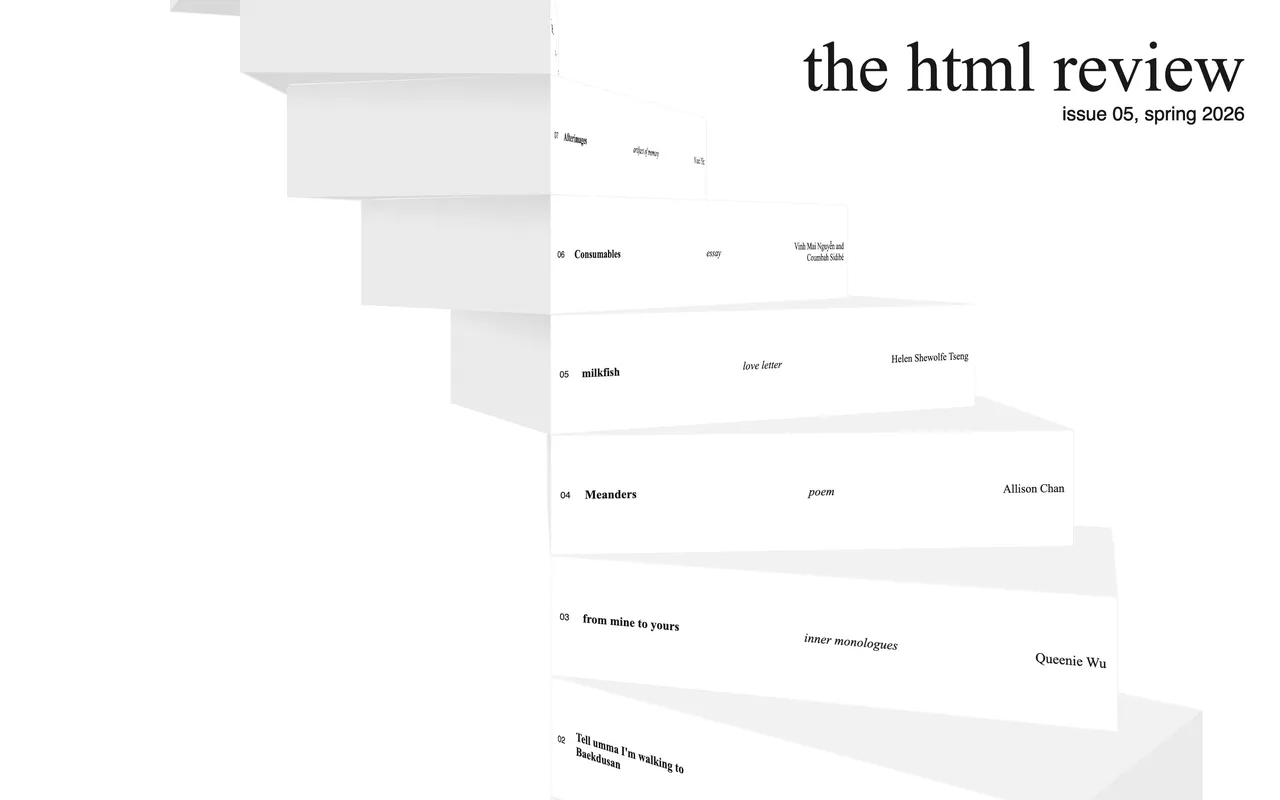
The HTML Review, an annual journal of “literature made to exist on the web”, edited by Maxwell Neely-Cohen and Shelby Wilson since 2022. Each issue is released on the first day of spring, and each piece is written for the web as a medium. thehtml.review
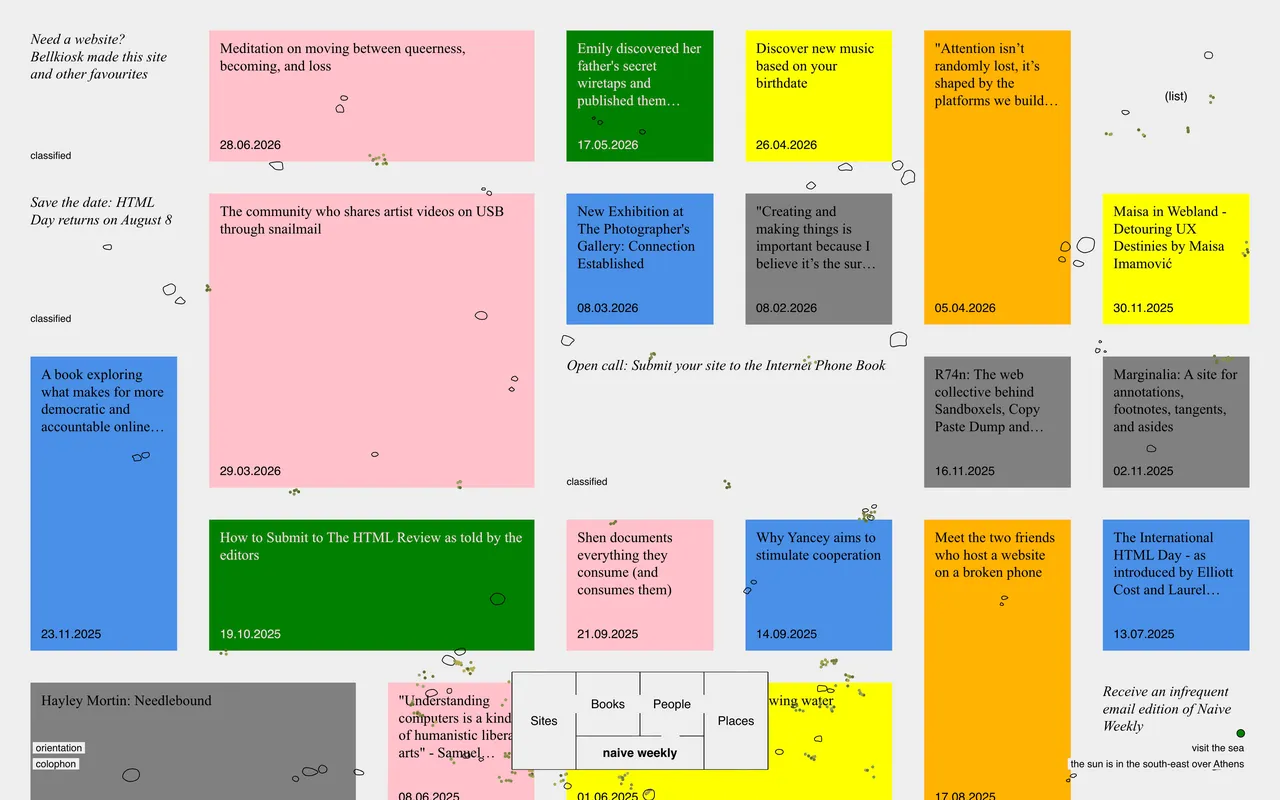
Naive Weekly, a newsletter by Kristoffer Tjalve, has sent links to “the quiet, odd and poetic web” every Sunday since 2018. Tjalve also organises Naive Yearly, a gathering about the web as a medium and material, whose 2024 edition took place in Ljubljana. naiveweekly.com
Many of these makers describe websites with words taken from architecture and gardening: rooms, houses, homes, gardens, sites. The metaphor treats a website as somewhere you stay and take care of, rather than a feed you scroll through.
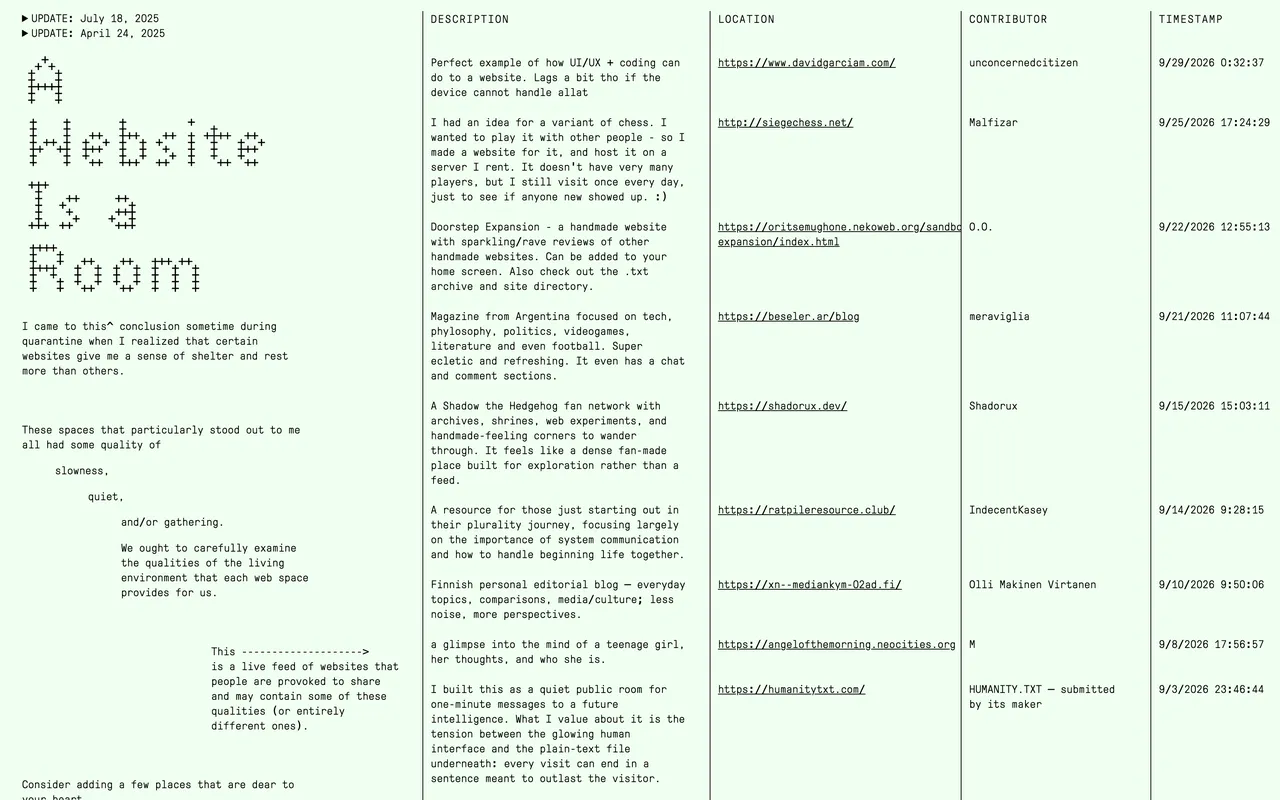
A Website Is a Room, Nancy Wu, 2021. Made during the pandemic as a thesis project at UCLA, it collects websites that visitors describe as rooms, with interviews of Mindy Seu and Laurel Schwulst. For Wu, “our dwelling within these web spaces is no less physical than our presence in actual rooms.” a-website-is-a-room.net
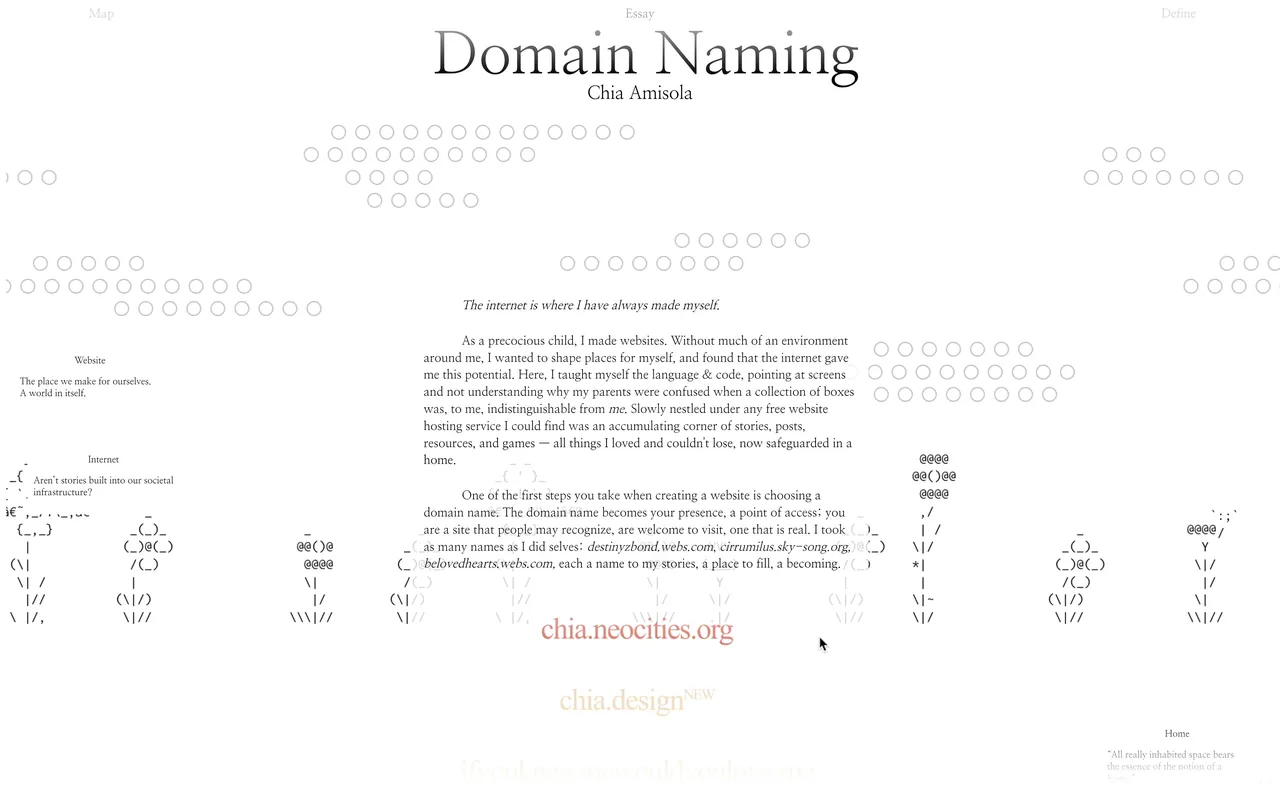
On domain naming, Chia Amisola. The artist and designer, based between New York and Manila, looks back at the websites she has made since childhood and at what it means to give a place on the web a name. For Amisola, a domain is “an invitation to start something new. A prompt.” ambient.institute/domain-naming
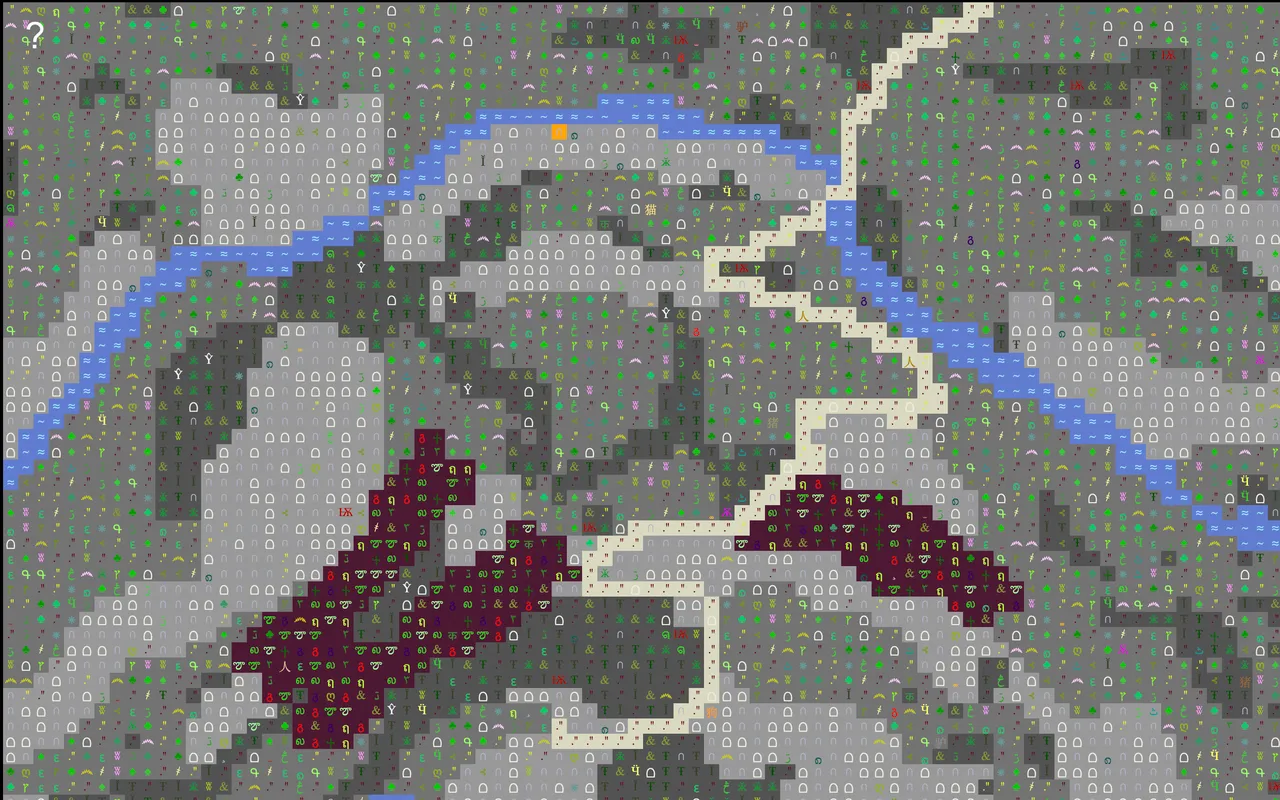
Permaculture Network, Gary Zhexi Zhang and Agnes Cameron, 2019, made for the Solitude & ZKM Web Residencies. The website draws Sakiya, an organisation dedicated to art, science and agriculture in Ein Qinyya, Palestine, with text characters, and imagines conversations between its plants, animals, soil, water and weather. Its code is public, so anyone can adapt it to another place. root.schloss-post.com
My teenage self still wants to be good at coding, but my current self just wants to stare out the window or through a webcam. If anything, don’t learn to code. Remain amateur.
Benjamin Earl, Coding in Situ, Naive Yearly, 2024
Benjamin Earl, who works from the shared studio Extra Practice in Rotterdam, designed with Kirsten Spruit the website of the Robida collective in Topolò, a village on the Italian-Slovenian border. The website follows the life of the place, with a scroll of the names of visitors and a calendar of what happens in the village. Earl calls this coding in situ: a website that lets people “sense the underlying infrastructure”. naive-yearly.are.na/2024/benjamin-earl
The handmade web has no fixed aesthetic: some of these websites look like 1997, others are minimal and typographic. What they share is a way of making, with small pages written slowly by one person or a few, and source code open for others to read and copy. A 1990s look is easy for a brand to borrow. A way of working is much harder to borrow, because it depends on how a website is made and maintained over time. The pages you write by hand in this class are part of it too.